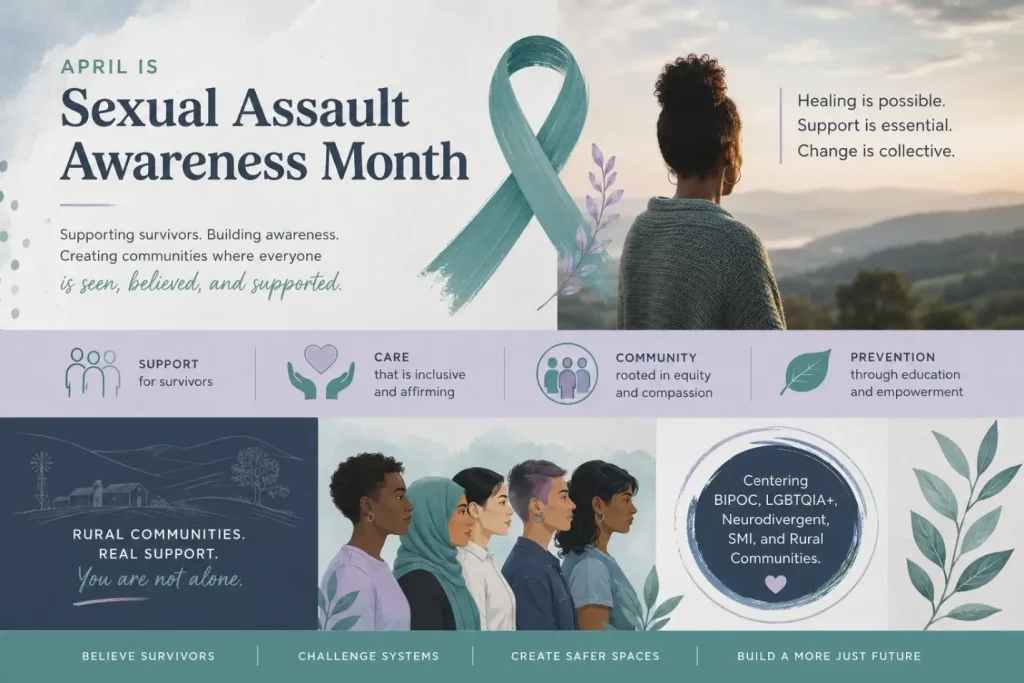
April marks Sexual Assault Awareness Month (SAAM), a national initiative focused on raising awareness about sexual violence, supporting survivors, and strengthening prevention efforts across communities. In 2026, SAAM continues to highlight a critical public health reality: sexual violence is not only widespread, but also deeply shaped by systemic inequities that affect access to care, safety, and long-term healing especially for BIPOC, LGBTQI+, neurodivergent, severely mentally ill (SMI), and rural populations.
At Mapping Resilience Therapy Center, therapist Krishana Overstreet, LCSW, provides trauma informed, culturally responsive care grounded in the belief that sexual trauma recovery must address identity, environment, and systemic harm not just symptoms. Her clinical work centers survivor autonomy, cultural humility, and intersectional healing.
Sexual Violence as a Public Health Crisis
The Centers for Disease Control and Prevention (CDC) estimates that sexual violence affects millions of people in the United States each year, with approximately 1 in 3 women and 1 in 6 men experiencing some form of sexual violence in their lifetime (CDC, 2024). However, these statistics are widely understood to be underestimates due to underreporting, stigma, and lack of access to reporting systems and care.
Recent Sexual Assault Awareness Month 2026 public health messaging continues to emphasize that sexual violence remains a persistent crisis shaped by inequality, with marginalized groups experiencing disproportionate harm and reduced access to justice and recovery services (National Sexual Violence Resource Center [NSVRC], 2026).
Disparities in Sexual Violence Impact
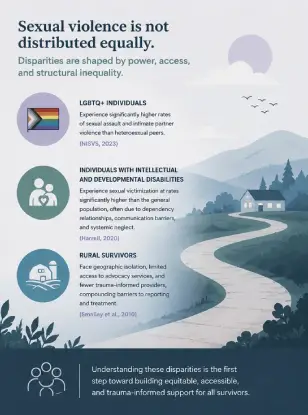
Research consistently shows that sexual violence is not distributed equally across populations:
- LGBTQ+ individuals experience significantly higher rates of sexual assault and intimate partner violence than heterosexual peers (National Intimate Partner and Sexual Violence Survey [NISVS], 2023).
- Individuals with intellectual and developmental disabilities experience sexual victimization at rates significantly higher than the general population, often due to dependency relationships, communication barriers, and systemic neglect (Harrell, 2020).
- Rural survivors face geographic isolation, limited access to advocacy services, and fewer trauma-informed providers, compounding barriers to reporting and treatment (Smalley et al., 2010).
These disparities reflect how sexual violence is shaped by power, access, and structural inequality not just individual incidents.
Case Examples: Intersectional Trauma in Real Life
A neurodivergent autistic adult seeking therapy after sexual assault may experience difficulty accessing affirming care if providers misinterpret shutdown responses, sensory sensitivities, or communication differences as resistance rather than trauma responses. Without neurodivergent affirming care, re-traumatization can occur within treatment systems themselves.
A Black transgender survivor living in a rural community may face compounded barriers including lack of LGBTQI+ affirming clinicians, fear of discrimination in healthcare systems, and limited transportation to trauma services. These intersecting stressors often intensify PTSD symptoms and delay recovery.
A Latina caregiver supporting a child after sexual abuse may experience secondary trauma, cultural stigma around disclosure, and financial stress that limits access to consistent mental health care.
These examples reflect what research consistently demonstrates: sexual trauma is both an individual and systemic experience that requires culturally responsive intervention (Campbell et al., 2009).
Trauma Informed Care for Sexual Assault Survivors
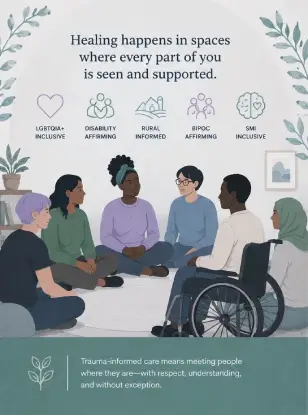
Trauma-informed care recognizes that sexual violence impacts both psychological and physiological systems. Survivors may experience:
- Post-traumatic stress disorder (PTSD)
- Depression and anxiety
- Dissociation and emotional numbing
- Sleep disruption and hypervigilance
- Chronic pain and somatic symptoms
- Identity disruption and relational challenges
Research shows that trauma informed, survivor centered care improves emotional safety, empowerment, and long-term recovery outcomes when it prioritizes choice, collaboration, and cultural responsiveness (Campbell et al., 2009).
Effective trauma-informed sexual assault care includes:
- Centering survivor autonomy and consent in all treatment decisions
- Integrating cultural humility and intersectional identity awareness
- Addressing racial, gender, disability, and neurodivergent trauma
- Using grounding and somatic stabilization techniques
- Supporting meaning-making and identity reconstruction after trauma
Moving Beyond Awareness Toward Structural Change
While SAAM increases visibility, 2026 public health discussions continue to emphasize that awareness alone is insufficient. Survivors need systemic change, accessible care, and accountability structures that prevent harm and support healing (NSVRC, 2026). Trauma recovery must be paired with broader efforts to reduce barriers in healthcare, legal systems, and community support networks.
At Mapping Resilience Therapy Center, Krishana Overstreet is a seasoned clinican with n extensive record of helping clients of all ages navigate towards recovery from sexual trauma. She provides trauma informed, culturally responsive therapy that supports survivors in reclaiming safety, autonomy, and identity after sexual trauma.
To begin trauma-informed sexual assault recovery support with culturally responsive care, schedule an appointment with therapist Krishana Overstreet at Mapping Resilience Therapy Center.
Moving Beyond Awareness Toward Structural Change
While SAAM increases visibility, 2026 public health discussions continue to emphasize that awareness alone is insufficient. Survivors need systemic change, accessible care, and accountability structures that prevent harm and support healing (NSVRC, 2026). Trauma recovery must be paired with broader efforts to reduce barriers in healthcare, legal systems, and community support networks.
At Mapping Resilience Therapy Center, Krishana Overstreet is a seasoned clinican with n extensive record of helping clients of all ages navigate towards recovery from sexual trauma. She provides trauma informed, culturally responsive therapy that supports survivors in reclaiming safety, autonomy, and identity after sexual trauma.
To begin trauma-informed sexual assault recovery support with culturally responsive care, schedule an appointment with therapist Krishana Overstreet at Mapping Resilience Therapy Center.